Reading Toward Racial Reckoning: A Conversation with Jacqueline White
Art and literature give us a unique window into realities we might otherwise overlook. They can serve as a launching pad for deeper discussion around topics that may otherwise be considered “too hard” or taboo. One of those topics: the ways in which white people engage (or don’t) with racism, especially as people of faith.
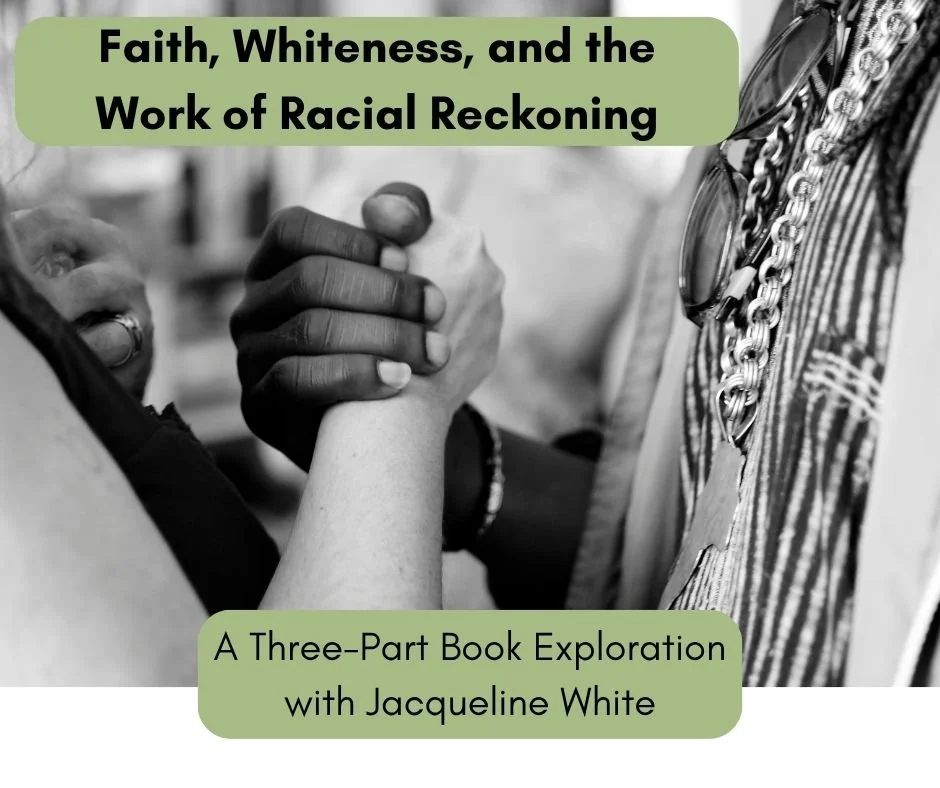
We’re excited to share that Jacqueline White will be leading a three-part facilitated discussion group inviting participants into this conversation. Using three texts as a framework for discussion—Gilead and Home by Marilynn Robinson, and Citizen: An American Lyric by Claudia Rankine—Jacqueline will facilitate nonjudgmental conversation around what it means to engage with racism in a spiritual context.
We had the opportunity to interview Jacqueline to learn more about her vision for this class and how facilitated discussion can be more fruitful than a lecture.
What inspired you to teach this class?
I created the class because it’s the class I wanted to take after reading Marilynne Robinson’s Gilead, which is an exquisite portrayal of the willed blindness of whiteness. In fact, the portrayal is so brilliant that it’s possible, especially for a white person, to read the novel and not even grasp its true subject. I found this out when I took a class on Marilynne Robinson’s novels that completely missed the roiling racial drama under the seemingly bucolic surface of Gilead. That’s when I realized I needed to teach the class myself!
Why pair these two novels by Marilynne Robinson with Claudia Rankine's Citizen?
I think white people need to hear from people of color about how our choices to not see the effects of racism land. Rankine, a Jamaican-American poet and MacArthur Genius Award recipient, takes us inside the experience of being Black in a white world. Reading Rankine in counterpoint with Robinson gives us the opportunity to hold the lived degradations of racism in tension with white people’s attempts to discount racism’s realities.
This discussion group (come to the first class having read Gilead!) is designed differently than a typical lecture series. What is the benefit of this structure?
There’s a lot of terrific nonfiction that investigates whiteness and racism, but encountering these topics through literature is different. It can help us get out of heads and into our hearts. So perhaps think of the class more like a book discussion group than a lecture series. I’m not trying to “teach” these books; I’m trying to create an opportunity for folks to “meet” these characters and, in so doing, perhaps hold up a mirror to their own lives. As we grapple with how human beings perpetrate and endure racism, the stories can become personal.
You describe your childhood experience of being involved in Milwaukee's civil rights organizing at St. Boniface Church as being deeply formative. How does that experience influence the conversations you hope this class will have?
While my childhood experience at St. Boniface felt heady and exciting—we’re making real change!—I’ve had to reckon with the fact that my hometown today is one of the most racially segregated cities in America. The only way I know to wrestle with the pernicious persistence of racism is to understand it as a spiritual challenge—and a spiritual call. While people of any faith or no faith are welcome in the class, I do want there to be space to approach questions of race from a faith perspective. Of course, that Gilead’s protagonist is a minister naturally raises questions about the role that faith leaders can play in enacting or alleviating racism.
Who do you hope will join these discussion groups?
I hope to create a brave space where people, especially white people who may not feel confident engaging with questions around race, can be vulnerable. As a white person committed to anti-racism work, I have to reckon with the fact that I keep making mistakes. I almost feel as if that’s my core work as a white person—to face up to the mistakes I make around race. So, the people who I hope will sign up for the class are other fallible people, especially those who are willing to own up to their mistakes too!
The conversation doesn’t end here. You’re invited to participate in this fall’s discussion group. Come with vulnerability and an openness to learning. All are welcome! Learn more and register here.